Now Reading: Flutter vs React Native: Cross-Platform Frameworks Compared
-
01
Flutter vs React Native: Cross-Platform Frameworks Compared
Flutter vs React Native: Cross-Platform Frameworks Compared

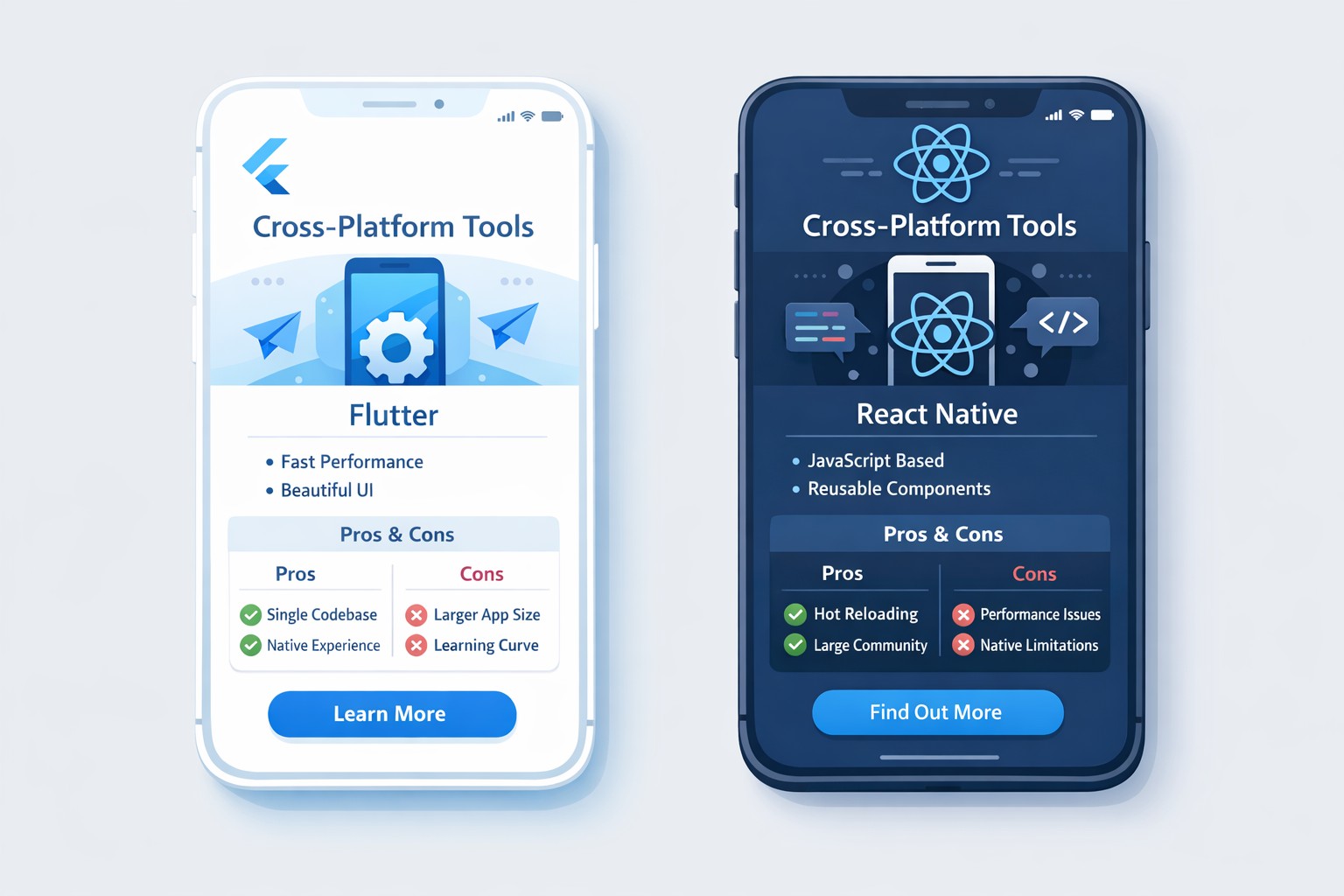
Flutter at a glance
Flutter is Google’s UI toolkit designed to build natively compiled applications for mobile, web, and beyond from a single codebase. It relies on the Dart language and renders its own UI components using the Skia graphics engine, rather than embedding platform-native widgets. This approach gives Flutter a high degree of control over visuals and behavior, enabling consistent performance across iOS and Android without depending on the native widget sets. For enterprise teams, Flutter’s architecture aims to minimize platform-specific drift while offering a cohesive development experience that covers the entire app surface, from visuals to motion to accessibility.
Because Flutter compiles ahead of time and includes a rich set of widgets that are drawn directly to the screen, developers can achieve predictable frame rates and smooth animations. The framework emphasizes speed in iteration, with features like hot reload that preserve the app state while injecting code changes. This model supports rapid experimentation and design exploration, which can reduce the time-to-market for feature-rich, cross-platform products. In addition, Flutter’s tooling ecosystem—from the Dart language tooling to DevTools—strives to provide an integrated workflow for building, testing, and profiling experiences.
- Compiled Dart language with ahead-of-time compilation and JIT for development
- Skia-based rendering pipeline for consistent visuals across platforms
- Extensive, customizable widget catalog that mimics and extends native UI patterns
- Hot reload and robust dev tooling for rapid iteration
- Google-backed ecosystem with strong cross-platform vision
React Native at a glance
React Native enables developers to build mobile apps using JavaScript and the React paradigm, with a bridge that connects to native UI components. Rather than rendering through a custom engine, RN renders real native views, which often aligns closely with the experience users expect on iOS and Android. This architectural choice means teams with web development or React experience can leverage familiar patterns and libraries while still targeting mobile platforms. For many organizations, the ability to reuse web logic and components across web and mobile workflows offers compelling efficiency, especially in product-driven companies that want to move fast with a shared skill set.
RN’s architecture emphasizes flexibility and ecosystem breadth. It benefits from a large JavaScript community, a vast array of libraries, and a long-running track record in production apps. While the bridge layer introduces overhead for complex animations or deep UI micro-interactions, careful architecture, native modules, and performance tuning can yield solid results. The platform has matured through years of real-world usage and a broad spectrum of case studies, giving teams practical guidance on scalability, testing, and maintainability.
- JavaScript-based approach with React principles and a Metro bundler
- Bridge to native UI components for authentic platform feel
- Large ecosystem of libraries, plugins, and community resources
- Hot reloading and live reloading support for faster iteration
- Backed by Meta with a broad, diverse set of use cases and contributors
Performance: native vs interpreted UI
Performance in Flutter hinges on its ahead-of-time compiled Dart code and its own rendering pipeline, which draws every element via Skia. This design minimizes reliance on the host platform’s UI controls and avoids repeated bridge crossings, contributing to consistently smooth animations and predictable frame rates. In practice, Flutter environments tend to deliver very fluid micro-interactions, rapid screen transitions, and stable performance on a wide range of devices, including mid-tier hardware. The trade-off is that the framework maintains a separate rendering surface from the platform’s native UI, which means developers design against a unified visual model rather than adapt native widget conventions.
React Native, by contrast, relies on a JavaScript thread that communicates with the native layer through a bridge or, in newer iterations, with more direct rendering approaches like the Fabric renderer. This can introduce latency in certain complex scenarios, particularly with heavy UI updates or deep nested components. However, for content-driven apps, forms, lists, and standard interactions, RN can feel highly responsive, especially when developers optimize rendering paths, use efficient list virtualization, and minimize bridging overhead. The practical takeaway is that React Native often delivers excellent performance with careful architecture, but Flutter’s architecture tends to provide more predictable performance out of the box for animation-intensive experiences.
Development experience and tooling
Flutter offers a cohesive development experience centered around the Dart language, its own tooling, and a unified set of debugging utilities. The Flutter CLI, Dart analyzer, and DevTools integrate with IDEs to provide strong autocomplete, refactoring support, and performance profiling. This tight integration tends to reduce the cognitive load on teams, especially when onboarding new developers, since the toolchain remains consistent across platforms. The developer experience emphasizes design-first workflows, with a focus on rapid iteration through hot reload and a predictable rendering model.
React Native shines for teams with existing JavaScript and React expertise. The learning curve can be gentle if developers are already comfortable with React concepts, JSX, and modern JavaScript tooling. However, the ecosystem’s fragmentation—multiple ways to handle navigation, state management, and native module integration—can introduce decision points and maintenance considerations as projects scale. Debugging across the JavaScript layer and the native bridge can add complexity, but mature tooling, third-party libraries, and community documentation provide practical guidance for common integration patterns and performance tuning.
- Flutter tooling offers a cohesive, integrated experience with DevTools and hot reload
- React Native leverages established JavaScript tooling and a broad ecosystem
- Language and ecosystem trade-offs: Dart’s cohesion versus JavaScript’s ubiquity
Ecosystem, maturity, and community
Flutter’s ecosystem is expanding rapidly, supported by Google and a growing number of contributors who build and maintain a wide range of packages, plugins, and samples. While the library surface is broad, there are still gaps in specialized native integrations, particularly for very platform-specific capabilities. As adoption grows, the community’s best-practice guidance and tooling continue to mature, reducing friction for feature parity across platforms. This momentum makes Flutter an attractive option for teams seeking a long-term, cohesive cross-platform strategy backed by a major tech company.
React Native benefits from a longer runway in the wild, with a large and active community of developers, extensive third-party libraries, and a rich set of examples from production apps. This maturity comes with its own considerations: updates and breaking changes in the bridging layer or native modules can require careful planning during upgrades. On the flip side, the breadth of available packages means teams can often assemble features quickly by composing existing solutions, a pattern that aligns well with agile development cycles and evolving product requirements.
Migration, maintenance, and long-term considerations
When thinking about maintenance, teams should weigh how each framework handles updates to APIs, platform-specific behavior, and native modules. Flutter tends to prioritize API stability within a given major version, with careful deprecation and a relatively straightforward upgrade path. Because the rendering surface is owned by Flutter, fewer platform-specific breakages tend to surface from minor updates, though developers should remain attentive to changes in the Dart language and Flutter framework itself that affect performance profiling and widget behavior.
React Native maintenance often centers on coordinating updates across the JavaScript layer, the Metro bundler, and any native modules your app relies on. Upgrades can involve adjusting native code, re-linking modules, and ensuring compatibility with the host platform SDKs. While this adds complexity, it also provides a path to capitalize on the latest web-driven patterns and native capabilities via well-supported modules. For teams with a long-running codebase or one that depends on numerous third-party libraries, this maintenance model frequently requires a proactive upgrade plan and clear governance around dependencies and native integrations.
Which framework delivers smoother animations and why?
Flutter generally delivers smoother animations by virtue of its own rendering pipeline and compiled Dart code, which reduces the need for costly cross-language bridging during animation frames. The framework’s consistency across platforms means micro-interactions feel similar on both iOS and Android, contributing to a cohesive user experience. React Native can also achieve excellent animation results, but it often requires careful optimization of the bridge usage, thoughtful component design, and sometimes native modules to achieve parity in complex motion scenarios.
Is React Native a better fit for teams with existing JavaScript skills?
Yes. Teams with strong web development backgrounds and JavaScript expertise can onboard more quickly to React Native, leveraging familiar patterns and tooling. This can shorten initial development cycles and enable cross-platform skills to scale across web and mobile projects. However, teams should plan for the potential complexity of bridging and native module maintenance as projects evolve, especially when targeting advanced platform-specific features.
How do platform maturity and ecosystem compare?
React Native has a longer track record in production apps and an extensive ecosystem of libraries and third-party modules, which can speed up development for many use cases. Flutter’s ecosystem is rapidly expanding and becoming more capable, with a growing set of plugins and packages, particularly around UI, tooling, and cross-platform capabilities. Each ecosystem brings its own considerations for maintenance, compatibility, and long-term support, so teams should evaluate not just current needs but also future plans for platform reach and vendor backing.
What should teams consider when planning migration or initial choice?
Teams should assess existing skill sets, the desired balance between design consistency and native feel, and the complexity of required platform integrations. If deep native API access and a vast web-developed module library are priorities, React Native can be compelling. If pixel-perfect visuals, consistent cross-platform rendering, and a cohesive tooling story are paramount, Flutter offers strong advantages. Additionally, consider long-term maintenance, vendor maturity, and the availability of talent in your region to sustain ongoing development and updates.